
Location; Thornton Curtis
Completion Date; Ongoing
This rural new-build dwelling in Thornton Curtis, North Lincolnshire, represents a thoughtful and contemporary architectural response to a countryside context. Designed for a private client, the home is located on a generously sized, well-screened site formerly occupied by a plant nursery. It lies outside the formal development boundary of the village, but within a loosely clustered group of historic and modern dwellings, including Thornton Hall and its associated stable buildings. The brief was to create a high-quality, low-energy home that would sit modestly within its setting while reflecting the client’s aspirations for a contemporary and enduring design. The client, who has strong personal ties to the land and surrounding properties, sought to develop a home that could support long-term occupancy, with adaptability and accessibility built into the design. The architectural response to the site’s rural character draws inspiration from the forms, scale, and materiality of traditional Lincolnshire farmsteads. The massing is deliberately simple and linear, reflecting barn-like typologies common to the local landscape. The proposed form and composition are designed to reduce visual dominance while retaining a distinctive architectural identity.
GARDENERS FOLLY
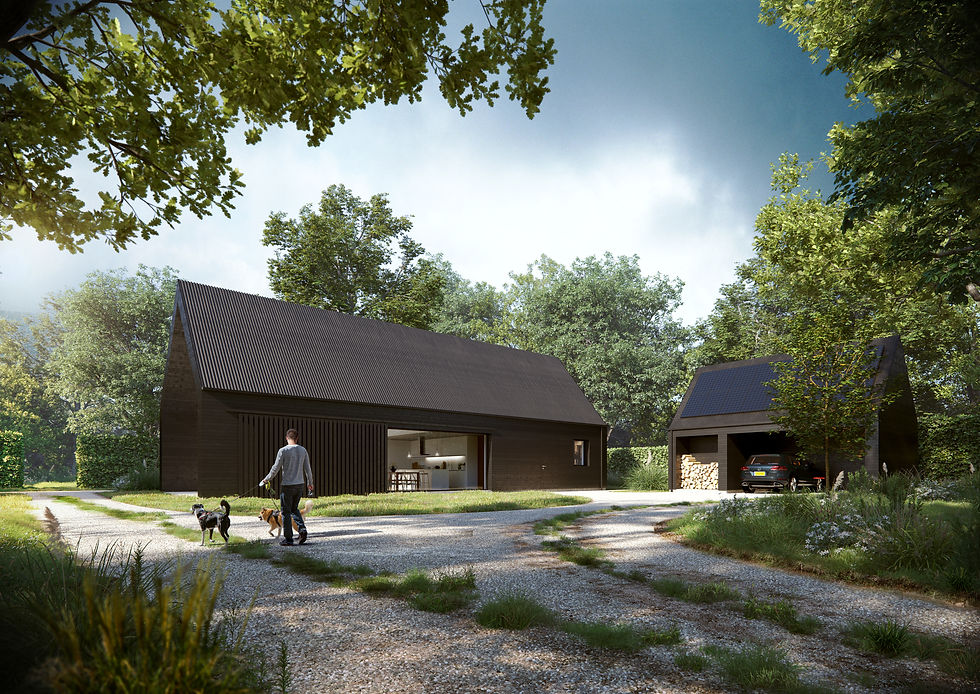


The house is oriented to optimise natural light and views across the open fields, with primary living areas arranged to the west and more private or ancillary functions located to the north and east. Large glazed openings frame views of the wildflower meadow and surrounding hedgerows, connecting internal spaces to the landscape while maintaining a compact and efficient plan. The entrance leads into a central spine from which all other rooms are accessed, with open-plan kitchen, dining, and living spaces arranged to the south-west, and utility, plant, and accessible accommodation to the rear. Two additional bedrooms at first floor level are located beneath a compact pitched roof and accessed via a gallery landing, served by high-level rooflights and offering views down into the vaulted space below.
A restrained material palette reinforces the building’s rural credentials and its relationship to the surrounding context. Vertical timber cladding, red brickwork and a standing seam metal roof are combined with crisp detailing to deliver a design that is both robust and refined. These materials were chosen for their sustainability, low maintenance needs, and visual continuity with local buildings. The use of timber in particular helps the dwelling sit softly within the existing landscape, especially as it weathers to a natural tone over time.
Planning permission for the dwelling was sought and secured under Paragraph 80 of the National Planning Policy Framework, which allows for new isolated homes in the countryside where the design is of exceptional quality or innovation. This route required the applicant and design team to demonstrate that the dwelling would be truly outstanding in its architectural ambition, would enhance its immediate setting, and would be sensitive to the defining characteristics of the local area. Detailed assessments of the landscape, site ecology, arboriculture, and visual impact were undertaken and used to inform the development of a design that responds sensitively to its context while exceeding national sustainability expectations.
While the site is technically considered countryside under planning policy, it is surrounded by other residential uses and includes the remnants of the former Palm Farm nursery, including derelict greenhouses, growing beds, and ancillary buildings. These structures were in a state of disrepair and visually detracted from the quality of the site. The new dwelling replaces these with a single, cohesive form that improves the aesthetic and ecological contribution of the land. Retained hedgerows and mature trees provide a high degree of screening from nearby buildings, including the listed Thornton Hall and its former stables, both of which are set back and largely obscured from view. The result is a building that is neither prominent nor intrusive and improves on the site’s current condition.
Landscape integration played a key role in shaping the proposal. The site benefits from existing mature vegetation along all boundaries and from an emerging orchard at its centre. The design team worked closely with ecology consultants to develop a plan for biodiversity enhancement. This includes the planting of additional native trees, enhancement of hedgerows through traditional laying and infill planting, the establishment of wildflower grassland, and the creation of new hibernacula and insect habitats using retained deadwood. These measures contribute to a significant uplift in ecological value and help the site function as a wildlife corridor within the wider agricultural landscape.
A new wildlife pond, covering between 250 and 300 square metres, has been proposed to the west of the property. Designed to capture low-nutrient site runoff, it will create a rich habitat for amphibians, insects, and birds, complementing the wider planting strategy.
All proposed lighting is wildlife-sensitive, with directional fittings and low-level luminaires to minimise impact on nocturnal species. The access road, once serving the nursery, is to be improved but kept informal with gravel surfacing, allowing for continued permeability and natural drainage.

At the heart of the proposal is a deep commitment to sustainability. The house is designed to meet the rigorous Passivhaus standard, ensuring extremely low energy use, high levels of thermal comfort, and exceptional air quality. A fabric-first approach underpins the construction, with high-performance insulation, airtight detailing, triple glazing, and the elimination of thermal bridges all contributing to energy efficiency. Heating and cooling demands are reduced to the point where a conventional heating system is no longer required. Instead, a mechanical ventilation with heat recovery (MVHR) system ensures continuous fresh air and heat retention. Solar PV and other renewable energy technologies may be incorporated as part of the final build.
Passivhaus was selected by the client and architect not only for its environmental benefits but also as a robust and measurable standard that would guide construction quality and ensure longevity. This is the first new-build Passivhaus dwelling in North Lincolnshire and serves as a model for sustainable rural living. Its delivery will bring new skills and knowledge to local contractors and supply chains, offering long-term value to the area’s construction industry and setting a high bar for future development.
The planning process involved close consultation with North Lincolnshire Council, specialist consultants, and the local community. The application was supported by detailed design analysis, landscape appraisal, and precedent studies, which demonstrated both the architectural and environmental merit of the scheme. As a result, approval was granted, recognising the dwelling as a valuable and well-considered addition to the local built environment.
The resulting design is a home that not only meets the needs of its occupant but also enriches its site and setting. It is a contemporary building that pays respect to the agricultural history of the area, the family ties of the client, and the evolving expectations for rural housing. Its form is modern but appropriate, its materials grounded in place, and its performance exemplary. Through this project, the team at ID Architecture have shown how high-quality, environmentally conscious design can emerge from careful site analysis, local knowledge, and a collaborative approach. The home is a response to both personal heritage and future sustainability, and it stands as a benchmark for architectural excellence in the countryside.
GALLERY


